
Featured image from The Fast and the Furious: Tokyo Drift
I cruised right through 2020, but 2021 decisively kicked my ass. As most people likely to be reading this know, my dad died in the spring. I wrote about his life here. Not long after, I had to euthanize my beloved dog. I wrote about the compounding grief I experienced here. At the same time, shit got stressful at work, due to the same sort of administrative marauding that campuses across the country have seen. This stress has mostly blown over for now, but I must say that I harbor abiding resentment that I had to worry about evil university administrators gutting the humanities the entire time I was trying to cope with the most profound grief of my life. I doubt I will ever again be able to truly say that I love the university where I work. I love my colleagues and students, but the constant reimagining and reorganizing and reprioritizing initiatives that have taken over the institution’s identity are fucking abusive and I am sick of it.
On the plus side, I finished writing my book, and it was published yesterday. I was fortunate in that I have been consistently able to focus on writing throughout the pandemic. This is no doubt because I was working on a book that is NOT written in a strangled academic style and where I did not have to cite a damn thing unless I wanted to. God, it felt so good to take off the sweaty rubber clown suit of professional norms and just write. I took genuine joy in writing, even while I was otherwise overtaken by grief.
I watched 1060 movies this year. That’s a lot, I know. But it’s 200 less than last year, so I have lived up to my vow to cut back. Here’s how I think of it: it’s like eating seasonally. Berries are really good in the spring, so I eat berries, and I don’t bemoan the fact that it’s not butternut squash time yet. Come October, out comes the squash. There have been years of my life where I’ve watched a mere few hundred movies and spent most of my time doing normal person shit. The pandemic is movie time. This shit is ripe. Honestly, I NEVER watch as many movies as I want to. I’ve watched 145 movies just in December (post-grading binge) and my watchlist has been growing *much* faster than I am chopping it down. There are a lot of movies! And the more interested I get in the art form, the more of them I want to see. It’s not a drag, it’s not boring, it’s not repetitive, it’s not depressing: I love it. There is a tipping point (after watching 8 in a row on Halloween I couldn’t look at a movie the next day), but for me it is very high. I don’t play video games and I barely watch sports. I love movies. That’s me. I am not trying to convince other people to adopt my way of life (probably don’t), but I have no interest in being talked out of it. I may rejoin society at a later date, pending certain variables.
This year, though, my film diet saw some noticeable shifts. I watched significantly fewer challenging bucket list titles. This is, no doubt, because my fucking dad died and I was really stressed out for long stretches and I couldn’t sit still and focus the way I have in recent years. In 2020 I watched stuff like Shoah and Dead Souls. In 2021, I watched 18 Adam Sandler movies. It was a different vibe.
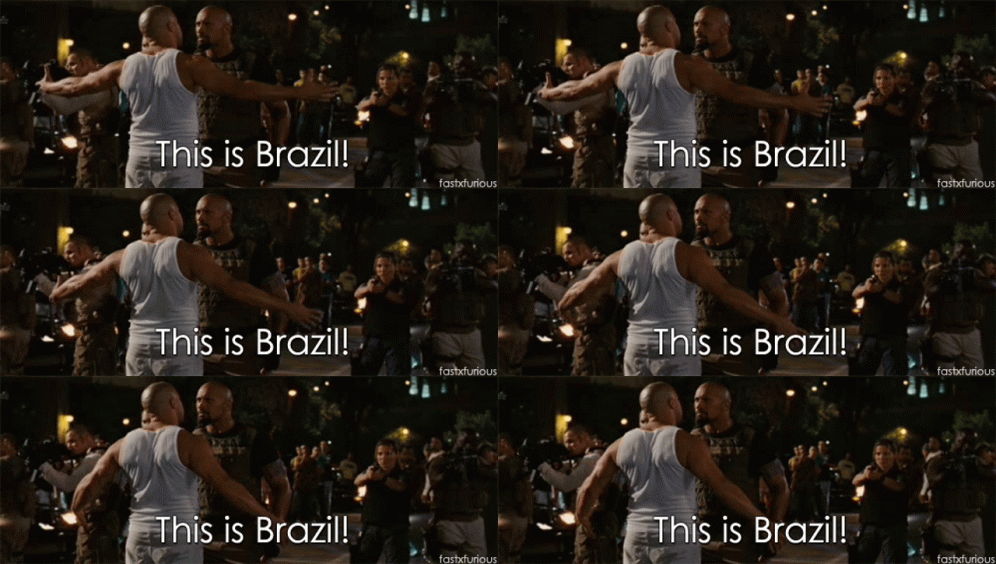
I thought a lot about the idea of a “comfort movie.” What movies do people reach for when they are sad or hungover or depressed and they want a movie that works as medicine? I asked around, and the answers I got confirmed my suspicion that this is wildly subjective and idiosyncratic. What did I turn to the day my dad died, when I was in so much pain I could barely move? The Fast and the Furious: Tokyo Drift. Then I watched Fast & Furious 6. Then Fast Five. At some point not long after I watched Furious 7 twice. Then I watched the early ones and part 8. I also watched MacGruber and Fifty Shades of Black. This is important data! I wasn’t putting on a performance for myself in these moments. I was in desperate need of something to quench the goddamn fire and this is what I reached for. This is what helped. This is what made me feel better when I was in the worst pain of my life. The Fast and Furious movies are about the way that family loyalty can be a super power. Just take the wheel, you know? And I really wanted Vin Diesel to take the wheel for me that week.
Over the months that followed, Adam Sandler made me feel better. Don “The Dragon” Wilson made me feel better. The American Pie Extended Universe made me feel better. Something like American Pie Presents: Band Camp is pure comfort, but instead of a mug of hot cocoa, it’s people getting caught masturbating in embarrassing contexts. Sometimes I drank hot cocoa while I watched, and it was good medicine.
Overall, I watched way more comedies this year than previous years. I watched 25 Lubitsch movies and a whole lot of trash. I also watched a shit ton of action movies and Old Hollywood fare, but that is not a new development. I watched less horror and arthouse titles (though still a lot), because this stuff just did not fall into the right zone of narcotic comfort that I needed to dwell in this year. There were certainly some cross-overs, though: Wishmaster, for instance, is one of my absolute top comfort movies. I fell asleep watching it many a night.
Out of my first-time viewings this year (bracketing the big chunk of Lubitsch, which was delectable), these were my top tier, in chronological order:
- The Crowd (Vidor, 1928)
- Leave Her to Heaven (Stahl, 1945)
- Caught (Ophüls, 1949)
- Artists and Models (Tashlin, 1955)
- The Tarnished Angels (Sirk, 1957)
- Sergeant Rutledge (Ford, 1960)
- Marketa Lazarová (Vláčil, 1967)
- Venus in Furs (Franco, 1969)
- Querelle (Fassbinder, 1982)
- Mélo (Resnais, 1986)
- Center Stage (Kwan, 1991)
- No Home Movie (Akerman, 2015)
And here were the rewatches that were most meaningful to me:
- The Grapes of Wrath (Ford, 1940)
- How Green Was My Valley (Ford, 1941)
- To Have and Have Not (Hawks, 1944)
- All that Heaven Allows (thee times) (Sirk, 1955)
- Written on the Wind (Sirk, 1956)
- Party Girl (Ray, 1958)
- Imitation of Life (Sirk, 1959)
- The Leopard (Visconti, 1963)
- Death in Venice (Visconti, 1971)
- Lancelot du lac (Bresson, 1974)
- Thief (Mann, 1981)
- Three Crowns of the Sailor (Ruiz, 1983)
- Tough Guys Don’t Dance (Mailer, 1987)
- The Killer (Woo, 1989)
- The Insider (Mann, 1999)
- L’Intrus (Denis, 2004)
- Gran Torino (Eastwood, 2008)
- Goodbye to Language (Godard, 2014) (in 3D, finally!!!!!)
- Knight of Cups (three times) (Malick, 2015)
- Song to Song (three times) (Malick, 2017)
Claire Denis’ L’Intrus was without a doubt the movie that gripped me the most this year. It was already a favorite, but I spent weeks obsessing about it after watching the restoration. I really needed to put it aside and write other things that I had actual deadlines for, but I did make some progress working through it. Here’s my piece on it. I spent a ton of time on Malick and wrote this piece on Knight of Cups and Song to Song. And here’s what I came up with on Sirk. Out of the other rewatches, Three Crowns of the Sailor and Death in Venice were especially revelatory. I feel like I made big leaps with both, and both are among the greatest movies I’ve ever seen.
I don’t like to rush to come out with takes on new movies (which is part of the reason we do our year in review on Oscar Sunday), but my favorite movie of the year is Titane. Winning Cannes didn’t do it any favors with the highfalutin cinephile crowd, though, and it has suffered an unfortunate hype-backlash cycle. I really want to write a longer piece on it, because I have been disappointed to see most of the people whose opinions I take seriously dismiss it casually after one viewing while the main discourse about it is caught up with extremely shallow issues about whether it’s shocking, offensive, tamer than it thinks it is, etc. In the two weeks or so when people were talking about Titane, I don’t think the discourse really got anywhere. I have watched the movie twice and spent months thinking about it and I’m still very much in the process of working through it. Hopefully, you will see a piece from me about it sooner or later. I also really loved Ferrara’s Siberia and Zeros and Ones and Eastwood’s Cry Macho.
So what’s next for me? With god as my witness, I am going to confront my most humiliating blind spot in 2022: Chabrol. It’s getting more humiliating all the time how little Chabrol I’ve seen. I’ve gotten it in my head that I am going to do a complete chronological watch-through, and so I keep passing on opportunities to watch random titles from the middle of his filmography. This time I’m really going to do it. 2022 is the year when I will watch every Claude Chabrol movie. Hold me to that, please, and see you on the flip side.



 STROHLTOPIA